
Speaker. Strategist. Provocateur of Useful Thinking.
Stephanie Crain
Expanding Perspective. Igniting Possibilities.
Corporate Mystic
Speaker. Strategist. Provocateur of Useful Thinking.
Stephanie Crain
Corporate Mystic
Expanding Perspectives. Igniting Possibilities

Authentic. Unconventional. Pragmatic.
Three words that don’t often go together, but with Stephanie, they blend into something part magic and perfectly useful in every way you need it to be. Stephanie doesn’t just present; she embodies her audience and reflects what matters most back to them.
People leave with new thinking, real tools, and questions worth sitting with.
Authentic. Unconventional. Pragmatic.
Three words that don’t often go together, but with Stephanie, they blend into something part magic and perfectly useful in every way you need it to be. Stephanie doesn’t just present; she embodies her audience and reflects what matters most back to them.
People leave with new thinking, real tools, and questions worth sitting with.
What Stephanie Brings to the Room
Stephanie is a natural storyteller. Personal experience, studied frameworks, and lived observation move fluidly through her presentations, not as separate elements, but as one continuous thread. She is the kind of speaker who will call herself out mid-sentence if something isn’t landing, pivot when the room needs something different, and find the humor in a moment without ever having planned for it.
This isn’t unpolished. It’s responsive.
She has performed, competed, presented, and been interviewed across contexts most speakers never encounter, from live television to large-scale stages to intimate rooms of graduate students. That range isn’t a resume line. It’s the reason she is genuinely comfortable in any room, and genuinely curious about the people in it.
Her goal is never to tell an audience what to think. It’s to help them become more naturally curious and less afraid of what they don’t yet know. People leave not just informed, but more aware of themselves than when they walked in.
Audience Reflection
One question.
Twenty-five answers.
One consistent theme.
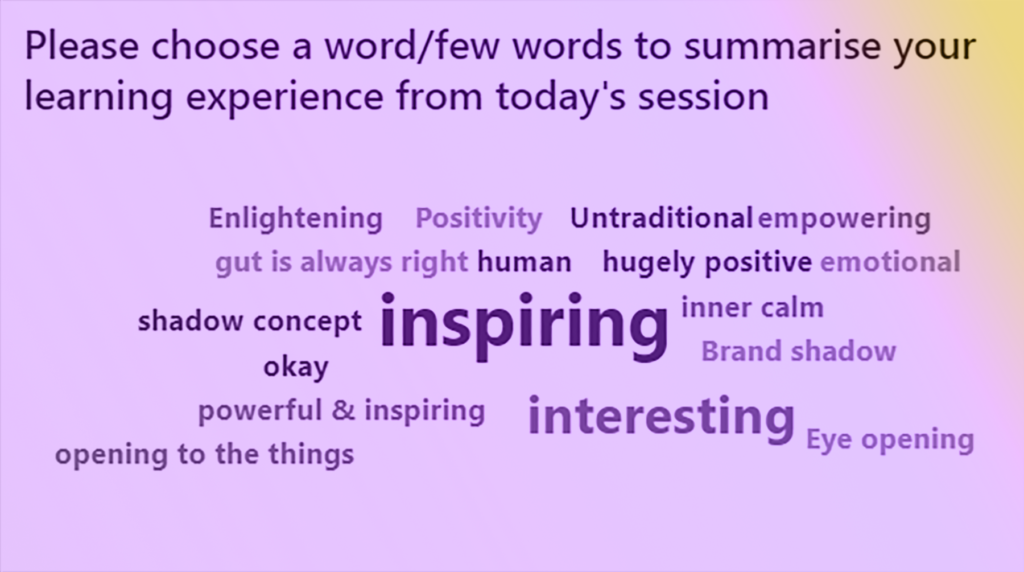
Audience response immediately following "Reaction to Response"
See Stephanie For Yourself
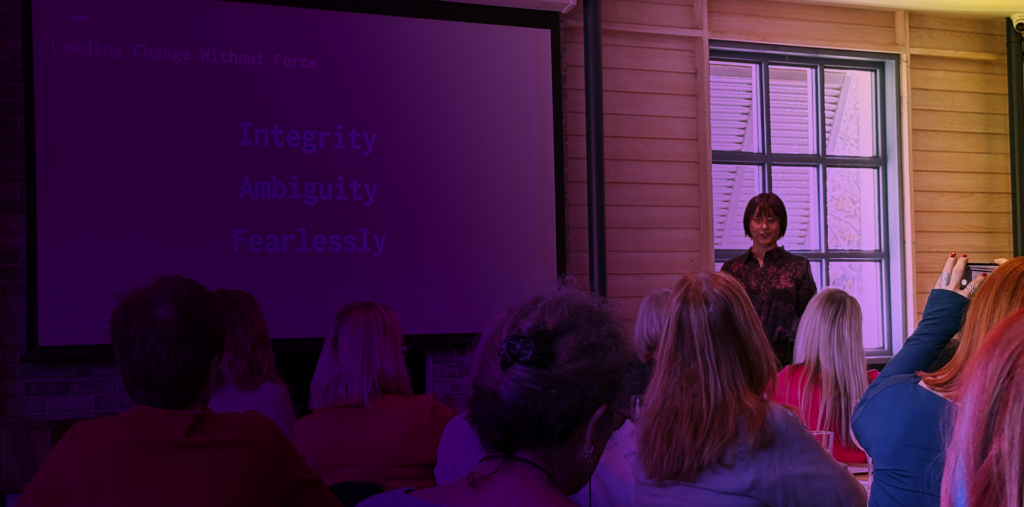
Delivered in 2026 to an audience of professional women navigating change and transition, this presentation on ambiguity, impermanence, and AI represents Stephanie’s speaking style in full.
Speaking Topics & Experiences
Every presentation is developed or adapted for the specific audience, context, and goals of the engagement. This can look like a formal talk, a presentation, a workshop, or a conversation. The following topics represent the terrain Stephanie works in most frequently. What it looks like for your people is worth exploring.
Change doesn't wait for readiness. Whether an organization is scaling, restructuring, or simply trying to function in an environment that keeps shifting, the challenge is rarely the change itself. It's the ambiguity that surrounds it, and the reactive patterns that ambiguity tends to activate. This topic meets audiences where most change initiatives leave them: somewhere between knowing something needs to shift and not yet knowing how to move.
Example presentation: Mastering the Art of Impermanence
The ability to move from reaction to response isn't a soft skill. It's an operational one. When individuals and teams can interrupt reactive patterns, manage their energy under pressure, and contribute intentionally to the spaces they're in, the entire organization functions differently. This topic brings the science and the practice into the same room, in a way people can actually use the next day.
Example presentation: Moving from Reaction to Response
Most people understand that personality shapes behavior. Fewer understand that behavior follows patterns, and that those patterns are identifiable, nameable, and workable. This topic introduces archetypal frameworks as a practical tool for self-awareness, team dynamics, and leadership development, drawing on Jungian depth psychology translated for the modern professional context. It is also where Stephanie introduces the Corporate Persona Archetype Test and the IAIMe™ framework for intentional AI integration.
Example presentation: Working with Archetypal Energy
The health of your culture is the health of your brand. When employees are disengaged, burned out, or disconnected from purpose, the customer feels it, even when no one can name exactly why. This topic explores the direct relationship between how people are treated internally and how they show up externally, and what organizations can do to close the gap between the experience they intend to deliver and the one they actually do.
Example presentation: From Root to Rise
Every organization has patterns that run beneath the surface. Decisions that repeat themselves. Dynamics that survive every restructure. Cultures that say one thing and do another. Shadow work, applied at the organizational level, is the practice of making those patterns visible so they can be worked with rather than worked around. This is some of the most significant work a leadership team can do, and among the least common.
Available for select engagements in 2026.
Fresh Perspectives Are Always Arriving
Currently Unfolding
New presentations are always in progress. Current work includes:
Organizational Shadow Work — making the invisible patterns in leadership and culture visible, so they can be worked with rather than worked around.
Energy Amplification — a breakdown of subtle energy, the role of Chakras in personal and professional life, and how to treat personal energy as the renewable, sustainable resource it actually is.
Innovation & Play — an exploration of how playfulness and creative thinking are not the opposite of strategic rigor, but the condition that makes it possible.
For a full archive of podcast appearances, interviews, and published features, visit Stephanie’s media profile.

Book Stephanie
Speaking inquiries are separate from consulting engagements. If you are exploring a presentation, workshop, or elevated experience for your team or event, the first step is a brief conversation.
Speaking Contexts
- Conferences, summits, and professional events
- Corporate leadership teams and executive audiences
- Graduate and academic audiences
- Public institutions and community organizations
- Audiences from intimate groups to 1,000+
- Media appearances: radio, live television, podcast, print