There is a lot of conversation around the concept of integration these days. It is something I talk about too, and I believe integration is something we can all work toward. But the more I think about it, the more I believe integration has become so important because it is a reaction to something else.
Compartmentalization.
Compartmentalization helps us manage complexity. It allows us to focus, organize, and make sense of the world. But when it becomes too rigid, it can also fragment our thinking, create blind spots, and quietly convince us we’re solving the right problem when we aren’t.
A Lesson in Compartmentalization
I learned one of the most important lessons of my career through my own healthcare.
Modern medicine is built on specialization. That’s one of its greatest strengths. But complex problems rarely stay neatly contained.
For years, I struggled with severe TMJ and chronic teeth grinding while I slept. I worked with my dentist, primary care physician, psychiatrist, physical therapist, sleep specialist, and eventually a neurosurgeon. Every recommendation made sense within the context of that provider’s expertise. Each specialist genuinely wanted to help. But I wasn’t getting better.
I was receiving excellent care. What I wasn’t receiving was a complete perspective.
After years of appointments, treatments, and thousands of dollars spent pursuing different solutions, I reached a point of frustration. Instead of scheduling another appointment, I asked for something I had never seen done before.
I asked every specialist involved in my care to join the same conversation. It wasn’t easy, but I pushed hard and, to my surprise, they finally agreed.
That one decision changed everything.
What happened next didn’t just change my medical plan. It confirmed that the conversation itself had been part of the solution.
Once convened, the conversation shifted almost immediately from certainty to curiosity. Instead of defending conclusions, the professionals began asking each other questions. Then, one physician recalled a recently published study connecting certain forms of teeth grinding with sleep apnea. Within minutes, years of assumptions began to unravel.
The teeth grinding everyone had been trying to stop wasn’t necessarily the problem. It was my body attempting to solve another one.
That single shift in perspective changed everything that followed.
Instead of continuing treatments that addressed the symptoms, I could finally focus on the system creating them. It didn’t solve every challenge overnight, but it stopped years of ineffective treatments, unnecessary expense, and the frustration of trying to fix the wrong thing.
What stayed with me wasn’t the diagnosis, but what made the diagnosis possible.
No one physician had been wrong… or exactly right. No one lacked expertise.
The breakthrough happened because highly capable people stopped working in parallel and started thinking together.
That experience reinforced the way I think about complex systems. I realized that specialization and compartmentalization aren’t the same thing. Expertise is essential and valuable. But compartmentalization shouldn’t lead to fragmentation.
The moment those specialists stopped viewing my health through distinct disciplines and began looking at the whole system, they discovered something none of them could have seen alone.
The Fragmentation Trap
It took determination to make that conversation happen. The goal wasn’t to challenge authority. It was to challenge a system that was contributing to the problem and limiting what was possible.
Most systems are built on rules that make perfect sense until they don’t. The difficult part isn’t recognizing that a rule exists. It’s recognizing when the rule has become more important than the outcome it was designed to achieve. I don’t believe that rules are meant to be broken, but I do believe that they are stronger when they are designed for evolution. Compartmentalization creates expertise. But without flexibility, it can also create fragmentation.
That’s one of the reasons I see the same pattern so often inside organizations.
Marketing. Operations. Technology. Product. Sales. Compliance. Finance. Human Resources. Leadership.
Each department is filled with intelligent people making thoughtful decisions based on the information available to them. Each specializes in seeing one part of the organization exceptionally well.
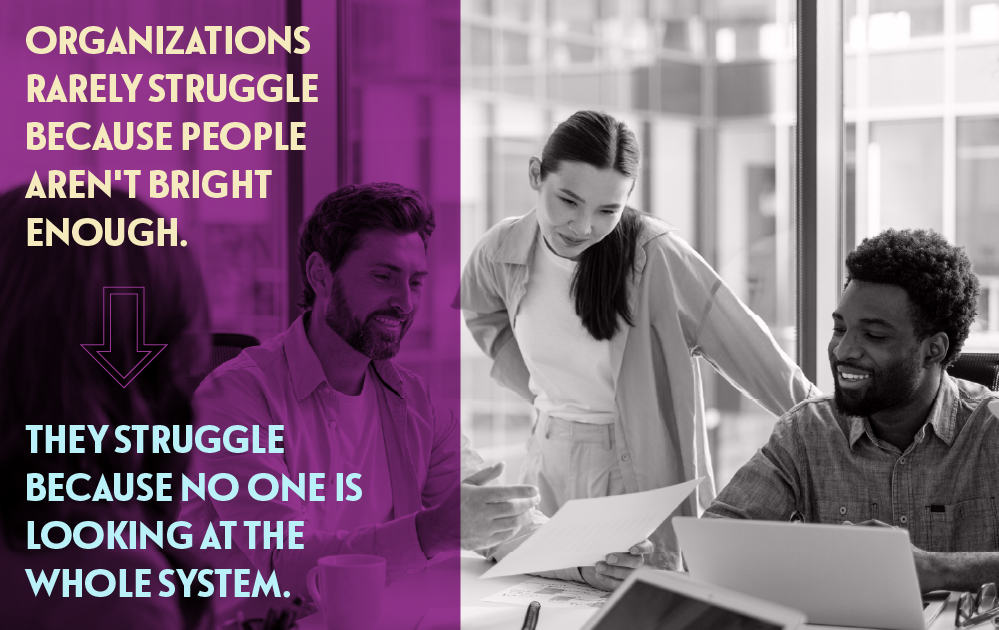
But organizations rarely struggle because people aren’t bright enough. They struggle because no one is looking at the whole system.
Sometimes marketing appears to have a communication problem when the real issue is leadership.
Sometimes one department is scapegoated because other areas of the organization lack an understanding of their value or purpose, instead treating them as an obstacle.
Sometimes companies spend years trying to break a pattern without understanding the cycles that are driving it.
The more complex the organization becomes, the easier it is to mistake specialization for perspective. They’re not the same thing.
Perspective doesn’t replace expertise.
It connects it.
That’s why I created the Perspective Gain Intensive™.
Not because I believe I have better answers than the people inside an organization.
Quite the opposite.
I believe most organizations already possess the knowledge they need. What they often lack is the opportunity to see it together. Sometimes a single conversation can reveal what years of effort could not.
Expanding perspective changes everything that follows.
The experience didn’t teach me something entirely new. It confirmed something I had intuitively understood for years. Expertise without perspective doesn’t eliminate blind spots. Often, it creates them.
Curiosity and objectivity create the space needed for perspective to expand. When people begin to explore problems in new ways, new possibilities emerge.
Where is expertise creating a bottleneck in your organization? Who needs to be talking to each other more?
Every system teaches us what questions we’re allowed to ask. Innovation often begins when we recognize we’re allowed to ask a different one.
Explore the Perspective Gain Intensive™ and discover what becomes possible when perspective expands.
Looking for even more insights? Check out the Conversations with the Corporate Mystic podcast.