

Total Team Transformation
The Adaptive Innovation Method™
Why Transform?
Transformation isn’t defined by only problems or possibilities. The catalyst for transformation can be both or either.
When a team needs to evolve, the catalyst can sometimes matter less than the need itself. The catalyst sparks the awareness, but only with deeper examination, and true objectivity can the actual needs be identified, so that transformation can happen.
Team transformation is very similar to individual transformation, just more complex because more points of view are considered. But the framework- the catalyst, awareness, identifying the root, going inward, developing clarity – all lead to solving, building, innovating, and creating vision. The key to success for teams lives in integration and sustainability.
With teams, the work begins with identifying the need. What is often determined early is that the perceived need is different from the actual need. For example, everyone’s focus might be caught up in the bright shine of an opportunity, blinding them to a critical gap. Conversely, what is perceived as a challenge or an obstacle might actually be an opportunity.
This is why objectivity and perspective are critical early in the process. It’s important to make sure you’re solving the right problem… If there’s even a problem to begin with.
Who This Is For
Every team arrives at this work through a different catalyst. Here’s what that tends to look like.
AI Curiosity and Resistance – Your team has been asked, sometimes told, to adopt new AI tools or ways of working, and what’s showing up isn’t really resistance to the technology. It’s whether people feel brought into the change or run over by it. The tool is the catalyst. What’s underneath is trust, curiosity, and fear.
Team-driven Silos – Two teams that depend on each other, like compliance and marketing, or technology and HR, can’t seem to collaborate, and what looks like a personality conflict might be a structural tension that calcified into a relational one over time.
Stagnant Productivity – Productivity has stalled. Burnout might be the cause, the cover, or both, and how clearly that’s already been recognized changes where this work actually begins.
Change Brings Change – The processes that used to work don’t anymore. That can be growth outpacing infrastructure, poorly managed change, or both. Either way, something needs to shift.
Communication & Trust – Trust within the team has eroded; not because of one event, but because something deeper was never fully addressed.
Mission & Purpose – The team can’t organize around a shared direction, whether that’s a new initiative, a structural change, or simply how the work gets done now.
Each of these is a starting point, not a diagnosis. What’s underneath might be exactly what it looks like. It might be something else entirely. The discovery is a part of the process.
The Adaptive Innovation Method
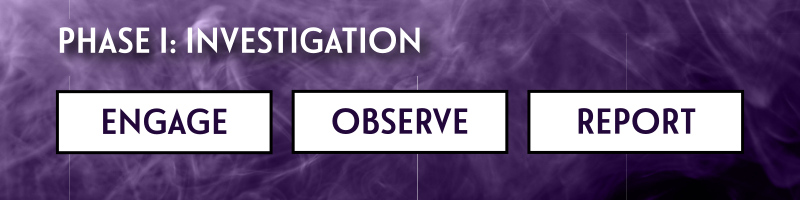
We begin without assumptions or bias. We question, listen, and observe without judgement. We trust you and what you describe while staying alert to what you leave out or can’t see. Then, we tell you what you told us, what we heard and saw, and what we believe it means.
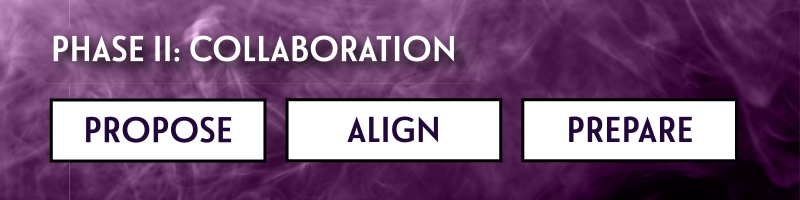
Our proposal is a tool designed to be flexible and accessible. It works as both a thoughtful guide as well as a complete set of recommendations. If your needs exceed our offerings, we provide referrals when able. The ultimate goal is to reach consensus to begin planning forward. This is a short but critical phase in the process. If consensus isn’t reached, or outlier issues aren’t addressed here, the success of the overall engagement is at risk.
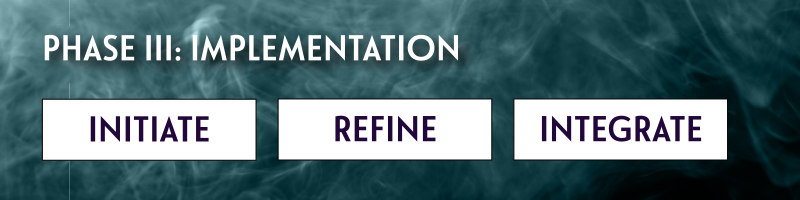
This is the action phase of the Adaptive Innovation Method. A tailored solution is designed, with the consideration of all key stakeholders’ input. Everything from Engagement to Implementation is approached with the goal of Integration as the result.
Part Strategy. Part Magic. All Results